Komiku: A Playful Font for Joyful, Creative Projects
There are moments in design when you need typography that doesn't just sit quietly on the page but actively participates in the story. Maybe you're packaging a line of organic kids' snacks, designing a birthday invitation for your best friend's daughter, or creating a social media campaign for a family-friendly event. In these cases, a serious corporate typeface feels wrong. You need something that smiles. That's exactly where a font like Komiku enters the picture—it's a typeface built specifically to radiate warmth and energy.
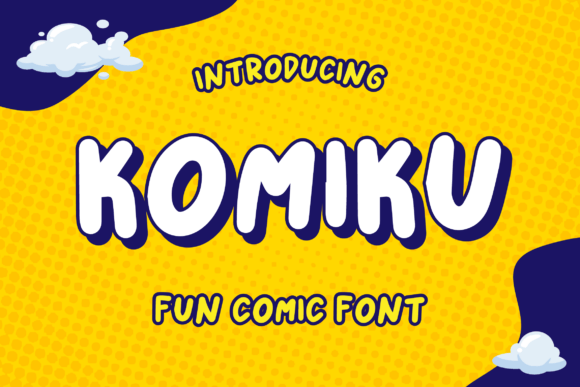
Visually, Komiku is characterized by its rounded terminals, soft curves, and a distinct "bounce" in its baseline. Unlike rigid geometric sans-serifs, this typeface feels organic and approachable. The letters aren't just shapes; they feel like they are moving. This dynamic quality makes it an excellent display font choice for headers, titles, and logos where you want to capture attention instantly. It bridges the gap between professional graphic design and the hand-drawn charm of a handwritten font, offering the best of both worlds: personality without sacrificing legibility.
Injecting Personality into Brand Identity
For entrepreneurs and small business owners, brand identity is everything. It is the silent ambassador that speaks to your customers before they read a single word of your copy. If your brand voice is friendly, educational, or whimsical, your typography must match that energy. Komiku works exceptionally well for businesses in the education sector, children’s apparel, or artisanal food brands looking to convey a sense of homemade authenticity.
Imagine using this typeface for a logo design. A serif font might imply history and tradition, while a strict sans serif font suggests modern minimalism. Komiku, however, suggests fun and interaction. It tells the customer, "We are approachable, and we don't take ourselves too seriously." This is a powerful psychological trigger in marketing. When used consistently across your website headers, packaging, and social media graphics, it builds a cohesive visual language that audiences learn to recognize instantly.
Practical Applications: From Packaging to Digital Screens
The versatility of a creative font lies in how well it adapts to different mediums. Komiku is designed to hold its shape whether it is scaled up for a large format poster or sized down for a mobile screen. Here are a few practical scenarios where this typeface shines:
- Packaging Design: On a shelf crowded with products, a playful, rounded typeface can stop a shopper in their tracks. It is particularly effective for product names on boxes for cereals, toys, or beauty products targeting a younger demographic.
- Editorial Layouts: In editorial design, such as magazines or children's books, Komiku can be used for pull quotes or chapter titles to break the monotony of standard body text, guiding the reader's eye through the page.
- Web Design: Using a modern typography choice like Komiku for H1 or H2 headers on a website can soften the user experience. It makes the content feel less like a corporate memo and more like a conversation.
- Invitations and Stationery: For crafters and hobbyists designing wedding invitations or party stationery, this font adds a touch of whimsy that formal script fonts sometimes lack.
Mastering Font Pairings and Hierarchy
One of the most common mistakes in visual communication is using a display font for everything. While Komiku is legible, its personality is best showcased when used strategically. A key principle of modern typography is contrast. You want to pair your "fun" font with something stable and easy to read for long blocks of text.
For instance, if you are designing a brochure, use Komiku for the main headings to grab attention. For the body text, switch to a clean, neutral sans serif font. This creates a clear hierarchy: the playful headers draw the reader in, and the clean body text keeps them reading without eye strain. This balance ensures your design looks professional rather than chaotic.
When testing font pairings, look at the x-height and letter spacing. Because Komiku has a distinct bouncy rhythm, it pairs best with fonts that have a steady, even rhythm. Avoid pairing it with overly decorative script fonts or other high-energy display typefaces, as they will compete for attention and result in a cluttered look.
Commercial Considerations and Asset Management
Before finalizing any design assets for a client or your own business, you must address the technical and legal aspects of your typography. A premium font like Komiku usually comes with specific licensing options. It is crucial to understand the difference between a desktop license (for printed materials and logos) and a web license (for embedding fonts in CSS).
If you are a content creator or marketer, ensure your license covers the scope of your usage. For example, if you are creating marketing assets for a client to use on their merchandise, you likely need a commercial license that permits embedding the font in digital products or printing it on physical goods. Always review the End User License Agreement (EULA) included with your commercial font purchase.
Furthermore, consider the file formats provided. You will likely need TTF (TrueType Font) or OTF (OpenType Font) for desktop use and WOFF or WOFF2 for web use. Having access to multiple styles—such as bold or italic variations within the font family—allows for greater flexibility in your visual communication without needing to install entirely new typefaces.
Final Thoughts on Visual Joy
Typography is a tool for emotion. While there is a time and place for the stark professionalism of a geometric sans-serif, there is an equally important place for fonts that evoke happiness. Komiku serves as a reminder that design can be playful without being childish, and professional without being stiff. By understanding its visual strengths and pairing it with complementary typefaces, you can create brand identity materials and social media graphics that truly connect with your audience on a human level.